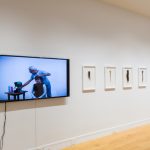
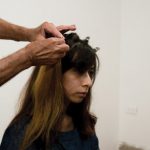
Humanities 103 students culminate the year with a final research paper. As I was wondering what exactly I wanted to research, my professor introduced me to a surprising artifact housed in the basement: six locks of hair taken from the heads of murdered women. These extensions are part of Extensión, an anti-femicide performance by Guatemalan artist Regina José Galindo. When I began to research the extensions, I quickly realized that they cannot remain in a Davidson basement, where they are inadvertently silenced.*
My paper (which you can read below or download as a pdf here) is just the start of this project, which I plan to bring to the attention of the broader Davidson community: seeking a permanent home for the extensions where they can be displayed to educate people on femicide.
Femicide can mean different things in various cultural contexts, but broadly speaking it is the deliberate sex-based murder of women. Women in Latin America, which is famous for its femicide rates, have already made great strides. The song “El violador eres tú” is an iconic symbol of their resistance to violence against women. However, the world hasn’t fully woken up to the issue or begun to effectively combat it. Femicide is not just an issue in Latin America, I would like to make that very clear. Domestic violence and other forms of femicide exist all around the globe, including here in the United States.
I’ll reiterate: femicide is everywhere. Therefore, while Galindo’s work is explicitly Guatemalan, the pieces are also relevant at Davidson. However, there are questions of cultural context, appropriation, ethical display, efficacy, and more which complicate the issue. (For more information, see the ethical display guidelines from the International Council of Museums.) There is also a need for supplementary materials to be displayed alongside the extensions. I welcome any informed ideas for where the extensions could go, what should be displayed with them, and who should be included in the decision making process. Please feel free to email these to me at radevecka@davidson.edu.
* The Davidson College Galleries house artifacts in this location for their protection and Galindo’s extensions would have to be rotated through periodically for preservation. The objects in the basement are technically open to student research, however few students are aware of Galindo’s work or its location, and finding a permanent display for the piece would more effectively promote its message.