Definition
noun
1 The study of what it means to be human, what humans do, and what we are capable of, through the lenses of the systems and institutions that we create (e.g. religion, politics, and language).
My Process:
The first project I was told about when I joined the Humanities program, was writing a definition of humanities. All over the world, schools and other institutions define the humanities in different ways. Typically it looks like sorting the courseload into STEM and humanities departments, but I want to show that it can be more than that. Much like science in Denis Diderot’s Encyclopedia of Human Knowledge, I think that there is a lot more to humanities than typical definitions give it credit for. Therefore, I wanted to write what Dr. Robb’s definition primer titles a prescriptive definition–one that would capture the full scope of what humanities can and should be, rather than how it is narrowly used. After consulting the primer, I used my red notebook as a jumping-off point, journaling my evolving ideas of humanities over a couple of months (below). Every unit of the course contributed something to my understanding of the humanities, and in the end I chose to give the broadest and most-inclusive definition possible.
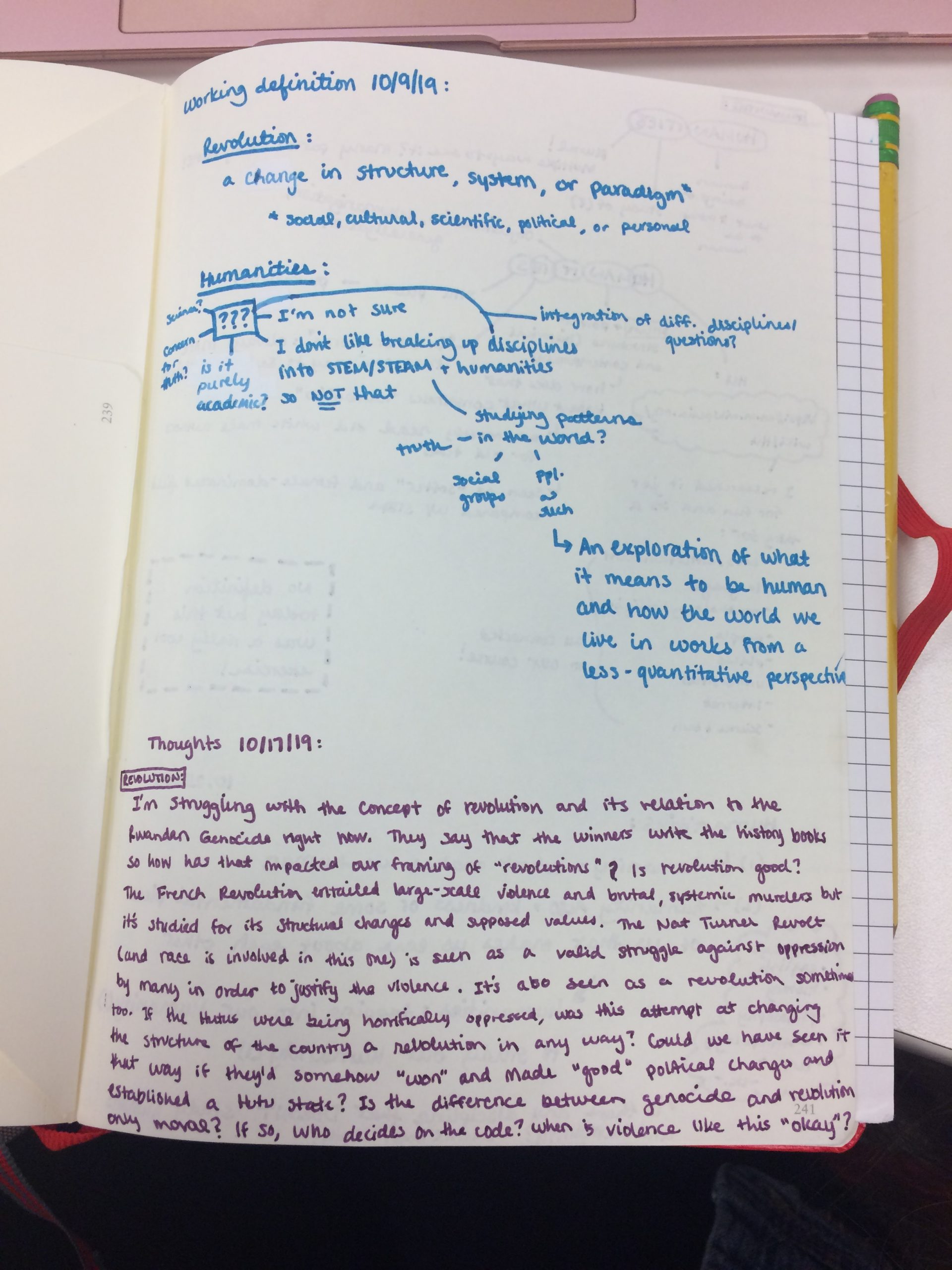


Journal entries examining the meaning of humanities.

Examples from the Course
Unit One:
Quite possibly the strangest feature of humans is that we spend much of our energy on creating institutions and using them to prove that we are human and everyone else is not. In the first unit, we studied what it means to be human from a philosophical and historical perspective. We discussed how our written texts and political institutions from the past created our identities and defined who was human and who was ‘other’. Specifically, we looked at how a narrow definition of property was equated with humanity by Locke, preventing Native Americans and poor people from being fully human. Moreover, we discussed how Locke’s defense of slavery defined blackness as inhuman and how historical systems have continued to reinforce these oppressive definitions.
Unit Two:
My favorite part of the second unit, was our analysis of human writing systems and how it is impossible to properly translate in between them. This was a philosophical look at one of the most important things humans do: communicate. A panel of guest professors spoke about how we create meaning. The meaning of a word, when produced, depends on the time, place, culture, and lived experiences of the speaker. Its meaning when received depends on the same factors in the audience. The two can never be certain that the listener hears the exact story that the teller recite. In the end, communication is not only one of the most important things which humans do, but something we are incapable of fully doing.
Unit Three:
In the third unit, we talked about how pain and suffering and how it can be both human and inhuman. The most complex discussion was centered on Susan Sontag’s arguments about photographic depictions of violence. We analyzed how the viewer feels sympathy – a supremely human emotion – based on the shared characteristic of having a body. However, the viewer is also infinitely removed from the situation and cannot truly understand all the complexities of the other person’s being. Photographs simplify a three-dimensional life to a two-dimensional moment that has already passed by the time it is captured. This usually ends up causing them to simplify and stereotype the situation and dehumanizes the sufferer in their eyes, even if that dehumanization is subconscious. Depictions of violence are thus contradictory: they rely on the humanity of the subject to bring out that of the viewer, stripping away the very humanity that they rely on in the process.
Unit Four:
The fourth unit was, in many ways, a response to the first one. We took the same historical, philosophical, and political definitions of who is and is not human, and looked at how the institution of Christianity defined and reinforced the same parameters. Specifically, we read Bible passages on slavery aloud and then discussed how beliefs about the superiority of the white race were justified biblically. We then focused on how the oppressed strove to take back their humanity through the same religion, as John Lewis’ book discussed. One of the most interesting revelations of the unit was how two individuals could look at the same religious texts and interpret them differently to oppress or to liberate, humanize or dehumanize.
Unit Five:
One focus of our fifth unit was the human trait of storing and passing on knowledge. We analyzed this through two systems: the archive and performance. The archive could be any physical object (a textual or art piece or other artifact) that is saved, whereas performance is bodily movement occurring in the moment. We discovered that even our systems of knowledge are used by people to humanize and dehumanize one another: performed knowledge, such as dance traditions, is usually either tokenized or defined as knowledge that disappears. Either way, such statements devalue cultures that employ performed knowledge. Many performance artists, such as the Urban Bush Women and Alvin Ailey American Dance Theater are seeking to reclaim the power of performance and use them to show the memories housed in human bodies–something which all humans share.
Unit Six:
In unit six, we used the framework of neuropsychology to see how humans perceive the world. One of the most fascinating things we looked at was color preferences. First of all, there was a clear cultural correlation between color choices. In Europe, blue was the most popular color; in Africa, it was red. This was just one small example of how cultural context impacts how people view the world. Not only that, but linguistic tags actually change color perception. People with distinct names for colors are able to observe different shades and hues. So the language one speaks literally changes the way in which their brain processes and views information. To connect this back to the translation panel in unit two–while it is somewhat possible to translate the name of a color into words, it is impossible to ever translate the identical perception of the exact shade of a color for a speaker of a different language. We learned that not humans not only create systems, but they actually create systems that end up controlling them! I would also argue here that neuropsychology as used in this unit would fall under the category of humanities, as it is a human system being used to study what humans do and are capable of.
Unit Seven:
In unit seven, we studied the history of Stalin’s Terror and Soviet Russia to ultimately examine one of the most terrible things humans are capable of doing: forgetting. We discussed the trajectory of the Terror, its acknowledgement, its burial, and its strange resurgence in the form of Stalinist nostalgia in present-day Russia. This is a cycle I see over and over again with traumatic events. Not only in the Terror, but also in the Rwandan Genocide and in the Holocaust, people began by denying and rationalizing what was happening–trusting their systems. When they realized what was happening, they focused on survival. It was only afterwards that the events were processed in novels, poems, and other art forms. Though people promised to share these widely so it would never happen again, they tired of being reminded. As Dr. Ewington put it, “Nobody wants to hear Gulag memoirs anymore.” Then, slowly and strangely, people begin to rationalize away what happened again or to forget the details and even to feel nostalgia for the old ways. When they don’t like the present, humans often turn to the past, rewriting history to make it more comfortable. Human capacity to forget is almost as impressive as human capacity to survive. And perhaps this is the reason that we see history repeat itself so destructively.
Unit Eight:
We spent much of unit eight diving deep into the history and art of post-war Germany. One issue we returned to frequently was the suicide of Ulriche Meinhof and her fellow RAF members. We opened the year reading John Locke’s theories on property, in which he stated that people’s sole properties in a state of nature were their bodies and their lives. In the final unit, we discussed suicide as a way of turning your life into a political tool (as Meinhof did) or taking control of an impossible situation (as Baader and Ensslin did). As I thought about it, I realized that human death has tremendous power. It turns a protest into a terror attack. It is murder. It is a tool and a violation. While it isn’t necessarily good, it always means something because human life means something. Life and death are the two final things that all people have in common. Though unit eight didn’t clarify what exactly “human” is, it emphasized one point; at the end of the day, we all have two things: we are human, and we are alive.


Three big questions of humanities: What is human? How do we understand? How does our knowledge work and what does it leave out?
