Definition
noun
1 A shift in paradigm (i.e. systems, power structures, beliefs, or modes of thought) that is brought about by people through some sort of force, whether that be violence, dissemination of new ideas, or ‘soul force’ (i.e. nonviolent organizing). This shift can occur within different groups or at the societal level.
My Process
Defining revolution was a yearlong project that began at our pre-orientation retreat and, if I’m honest, is still unfinished. To begin, I read Dr. Robb’s definition primer and decided I wanted to write a descriptive definition–one that would capture the full scope of human revolutions from the French Revolution and Scientific Revolution through the Civil Rights Movement. Then I spent a couple of months journaling my evolving ideas of revolution in my red notebook (below). Each unit of the course contributed something to my understanding of revolution, as did our fall break assignment of reading Lapham’s Quarterly on Revolutions and analyzing the examples. Now that I have a definition, my focus is on how we can start a revolution. Specifically, I want to shift the paradigm of humanity away from creating the difference-based hierarchies that lead to discrimination.
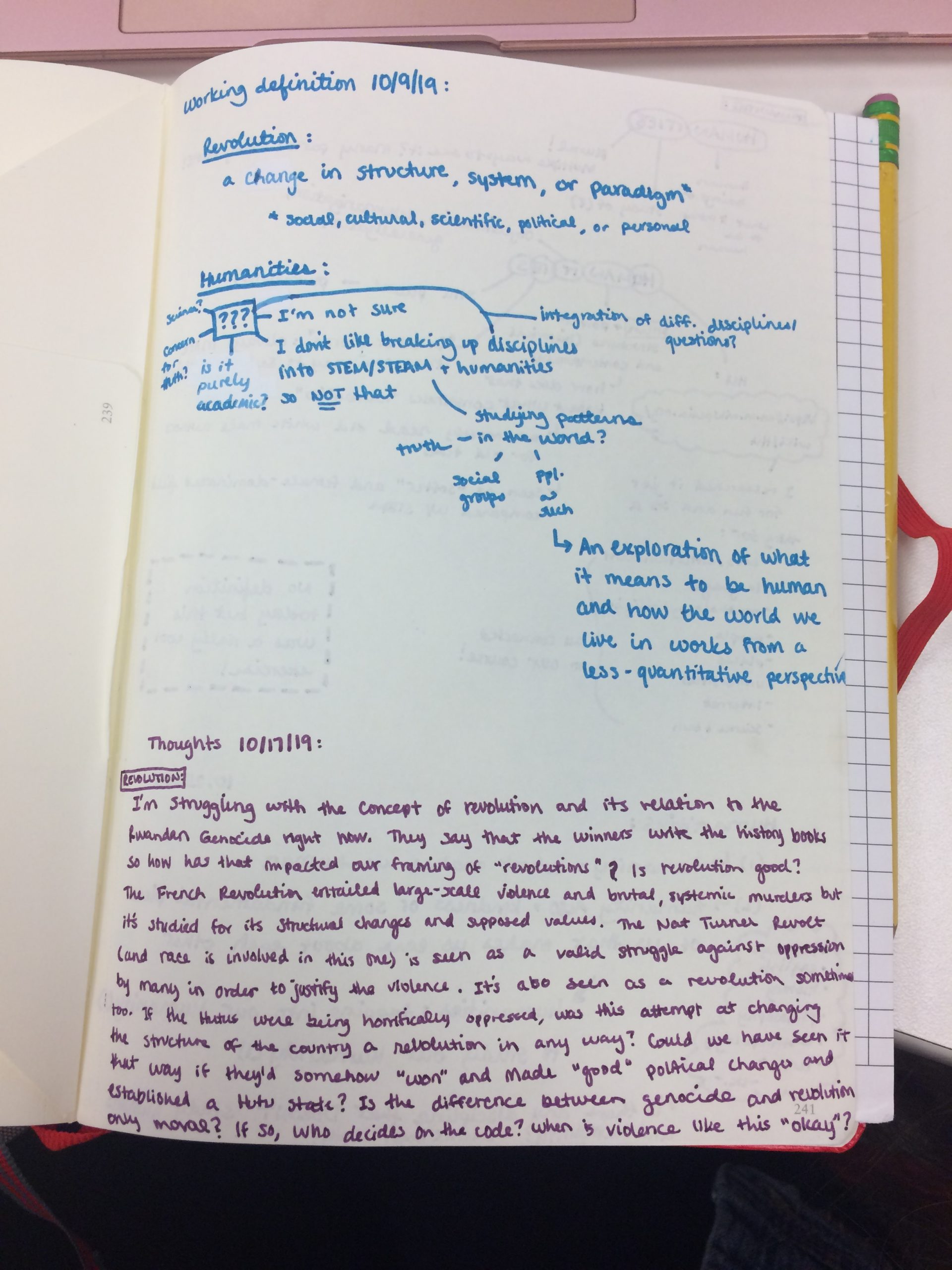

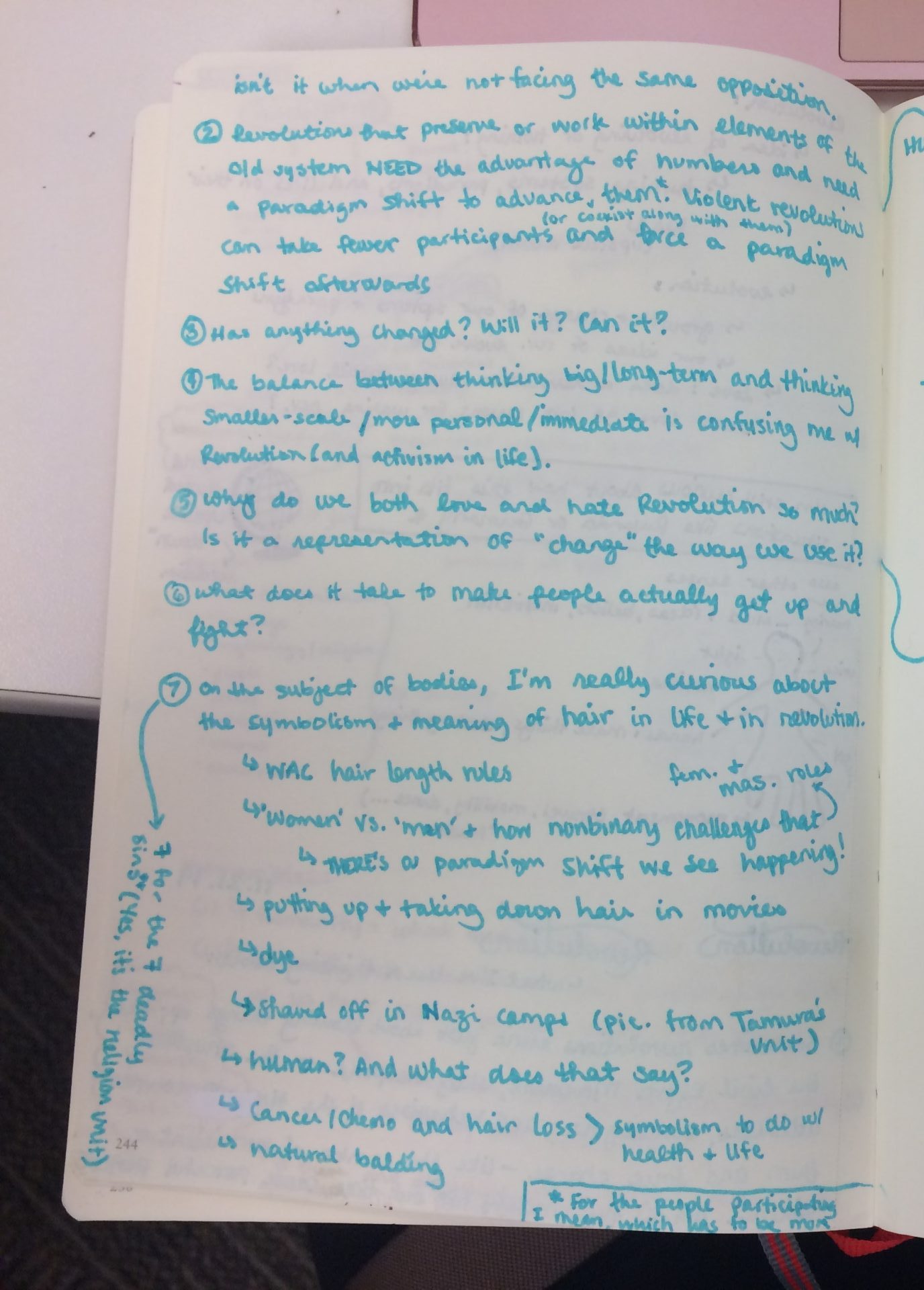
Revolution definition brainstorming journals.
Examples from the Course
Unit One: The Enlightenment
The Enlightenment was the first revolution we studied and it challenged my concept of what a revolution was, because it did not immediately involve a change in governments or power structures but was instead a revolution of the mind. Western Thought as we see it today was developed during the Enlightenment. People shifted away from believing in the divine rights of monarchs and democracy developed. Human rights ideals came into being, such as the rights to life, liberty, and property advocated by John Locke. An emphasis was placed on originality of ideas, experimentation, and proof. The Enlightenment was a shift in modes of thought, spread through active dissemination of ideas: writing, teaching, arguing, and lectures. This philosophical revolution also led to political shifts, such as the American and French Revolutions.
Unit Two: The Scientific Revolution
The Scientific Revolution was the focus of the second unit of this course. We used the word paradigm for the first time in this unit to describe the shifting of frames of reference or of beliefs. It was this idea that I eventually adapted into my own definition. The scientific revolution involved the separating of religious ideas from scientific ones. It involved the redefining of science as things that could be seen, felt, and proven experimentally. It also involved the development of new technology, which revolutionized societal norms and systems. New inventions and ideas were actively disseminated in lectures and writing, in schools, in propaganda, and by the most effective persuader of all: money.
Fall Break Assignment: Lapham’s Quarterly “Revolutions”
For fall break, we were assigned to read the Revolutions edition of Lapham’s Quarterly and think through the concept of revolution. I looked at ten different artifacts ranging from paintings to maps to quotes, but the piece that challenged my concept the most was “Deb Olin Unferth Joins the Circus.” This is a short memoir of a couple’s traveling to Latin America in an attempt to find a revolution to join. The piece made me uncomfortable in a way I couldn’t put my finger on for a few minutes. Then I realized: they were treating revolution like joining the Peace Corps. The memoir forced me to consider the ways in which revolution is often misused or misunderstood. People try to apply the concept of revolution as a bandaid for other cultures’ problems, not unlike some strange form of service work. Overthrowing a dictator you don’t like in someone else’s country does not qualify as a revolution. Revolution is incredibly nuanced, and requires the entire paradigm to shift. Is it possible to insert yourself into a space that isn’t traditionally your own and create a genuine paradigm shift? Would that even be a good thing to do? In addition, people have an absurd idea that a revolution is a panacea. When complaining about the ills of their lives, even ones as small as having to get up in the morning, they are often heard to say “We need a revolution in here!” or “I guess it’s time for the next revolution!” There is nothing wrong with change, but change for change’s sake can be an equally dangerous and terrible thing. And many of these changes are small and do not equate to what I believe is the enormity of a revolution. I came to the conclusion that I needed to be very careful to show the magnitude of a revolution in my definition and avoid tokenizing it or portraying it as a simple cure-all.
Unit Three: The Rwandan Genocide
The third unit, centered on the Rwandan Genocide challenged my concept of what a revolution is because it was the first unit that didn’t directly mention something good that happened. This led me to wonder: was the Rwandan genocide a revolution? Are all revolutions good? I would argue that they are not. In any shift of paradigm, there are winners and losers. Every revolution is bad for some people, so a revolution doesn’t have to be good at all. For example, John Lockes ideals gave birth to human rights discourse, but they also defined “human” as only white landowners. Given this perspective, I decided that the Rwandan Genocide was, in a way, a revolution. It shifted the paradigm of the power structures in Rwanda, empowering (albeit in a horrible way) the Hutus that had been historically second class citizens below the Tutsi people. This was a violent shift, caused by brutal murder, but it did accomplish its goal at the time.
Unit Four: The Civil Rights Movement
I have always considered the Civil Rights Movement to be a revolution. It dismantled many of the racist laws and systems in the United States and began a shift from a generally belief in the superiority of white people to a generally accepted belief that everyone should be equal. This revolution was accomplished through tremendous soul force and nonviolent protest on the side of many revolutionaries, but it also included writings, lectures, legal action, and violence from some revolutionaries and from the opposition. The intersectionality of the tactics used make this revolution unique. Another thing that makes this revolution interesting is that it wasn’t completely successful. Many oppressive systems still exist, and race is still grounds for inequality Thus the civil rights movement reaches another lesson about what a revolution is: revolution also lies in the struggle to shift a paradigm, regardless of whether it is successful.
Unit Five: Performance Studies
Unit five was the hardest one for me to grapple with intellectually. I had never dealt with performance studies before, and expanding my paradigm to incorporate performed knowledge was difficult. That was when I began to wonder about a complete versus a partial paradigm shift. Does a new paradigm have to erase the old one, or is an expansion to accommodate a new perspective enough? In order to answer this question, I turned to other examples of revolutions. The scientific revolution completely altered the way people think and the structure of society. The Hatian Revolution did not leave any room in its new power structure for French royalty. Therefore, although it is a change in modes of thought, I don’t believe that a mere expansion is enough of a shift to qualify as a revolution. So since I have not abandoned my old archival paradigm, unit five did not completely revolutionize my way of thinking, but I did expand it a lot.
Unit Six: Abstraction
The sixth unit, centered on a blend of abstract art and brain science, challenged my definition of where a revolution can exist. Does a paradigm have to be all-encompassing, or can it pertain to just one sphere of life? Specifically, was the abstract art movement a revolution? I came to the conclusion that within the art world, it was a revolution, because it was not only a shift in painting styles but a change in goals and modes of thought. There are different levels of society–the art community being one of them–and a revolution can occur within any of these groups.
Unit Seven: Stalin’s Terror
For unit seven, we focused on the terror which took place in the USSR under Stalin. The violence and horror of the time was carried out in the name of a supposedly ongoing revolution. For me, this raised the question: when is a revolution over? I would have initially said that Russia’s revolution ended when the government became communist, but according to Stalin this was untrue. His argument was that not everyone believed in the new order–or if you will, that not everyone had shifted to the new paradigm. If the terror was truly his attempt to force people to subscribe to his paradigm, then technically it could be considered a part of the revolution. However, based on the sources that we read in class, it seemed that most people in Russia were devoted communists and terror victims were arbitrary. If this is the case, as seems more likely, then the terror was not a part of the revolution, but instead Stalin’ power grab. Revolution can be dangerous in more ways than I had explored before. Not only is revolution a perceived panacea or a creator of hierarchies, but it can also be an excuse for atrocities and murder.
Unit Eight: Ulriche Meinhof and the RAF
In unit eight, which was focused on the leftist terrorism of Ulriche Meinhof and the RAF (aka the Baader-Meinhof Gang, I was left with a key question but no ultimate answer. What is the difference between a revolutionary and a terrorist? I saw many parallels between the civil rights and anti-war movements in the US and the protests in Germany; the biggest difference is that one was violent and the other was peaceful. But revolutions can be violent as well: take the American, Hatian, and French ones for instance. The biggest difference there is that each of those violent revolutions resulted in the creation of a new state. So is a non-state actor’s violence ever revolutionary, or is it always an act of terror? I have to be honest, I’m not exactly sure how I would define terror at this point, even after thinking about it for several weeks. If I ever return to this portfolio, I will try to consider the differences between terrorism and revolution in more depth.


Notes and examples of revolution from Lapham’s Quarterly.
Revolutionaries of Today
In thinking about starting a revolution, I decided to speak to revolutionaries. I wanted to ask them how they go about shifting paradigms and tackling broad, intimidating issues. The three men pictured below are true revolutionaries of today.* Jeremiah Smith is an education activist, seeking to restructure the education system of the Mississippi Delta–but he is also an activist for racial justice and community empowerment. Tony Simmons wants to shift the paradigm of how homelessness is viewed and prioritized in Baltimore, with connections to mental health, incarceration, and racial justice. George Mitchell is working to empower his majority-minority community in Baltimore City by restructuring its economic and social power systems to make it self-sufficient. Each of these drawings is made up of their words taken from an interview I conducted on revolution.
*Yes, my theme is feminism, and I did indeed conduct interviews with women. However, I was unable to acquire images of these women in order to create my drawings. I was planning to link everyone’s words–including the women’s–in PDF form, but unfortunately the interviews were accidentally deleted from my phone. But I would still like to thank Jackie Sofía, Mary Post, and Traci Wright with all my heart for their time and words.


Essential human rights: “Freedom, pursuit of happiness, and to love and be loved. Know how to love yourself.”
